Water
clusters
Water is, to use an understatement, important and interesting. It's also peculiarly challenging to understand. Clusters of water molecules are useful prototype systems for exploring the microscopic structure, bonding, solvation properties, and phase transitions of this fascinating substance. Systematic observations of the variation of cluster properties with size can be translated into insights about molecular motion and internal interactions. We're working with water clusters to study:
- Embedding of molecules within water clusters and implications for mass spectrometry
- The evolution of electric dipole moment
with cluster size
- The onset and development of solvation
See APS Physics Focus story: “Breaking up is hard to understand”,
New Scientist story: "Half a dozen molecules cause vital acid break-up",
Journal Club for Condensed Matter Physics commentary: "Quantum Acid-Water"
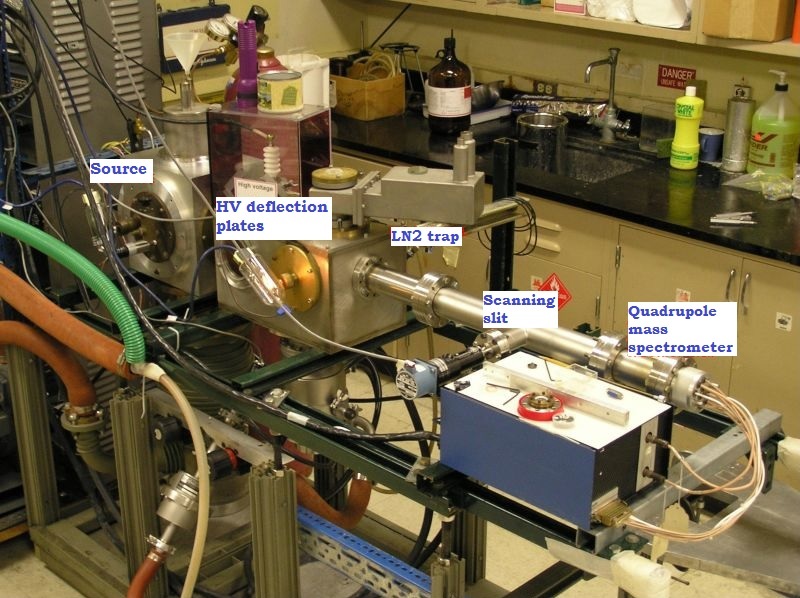
Water cluster beam apparatus
Water clusters are produced by expanding water vapor through a small nozzle into vacuum. They can then have other molecules attached to them, deflected by a strong inhomogeneous electric field, or subjected to other probes. At the end, they are ionized by electron bombardment and detected by a quadrupole mass spectrometer.